The Basics of Screen Printing Every Brand Should Understand Before Ordering
Screen printing is everywhere — on the T-shirt you're wearing, the tote bag by the door, the team jersey hanging in a locker room. Most people have been buying screen-printed products for years without thinking about how they're made. But when you're the one placing the order, understanding the basics changes the quality of every decision you make: the artwork you submit, the blank you choose, the shop you trust with the run.
Here's what every brand should understand before the quote goes in.
How Screen Printing Actually Works
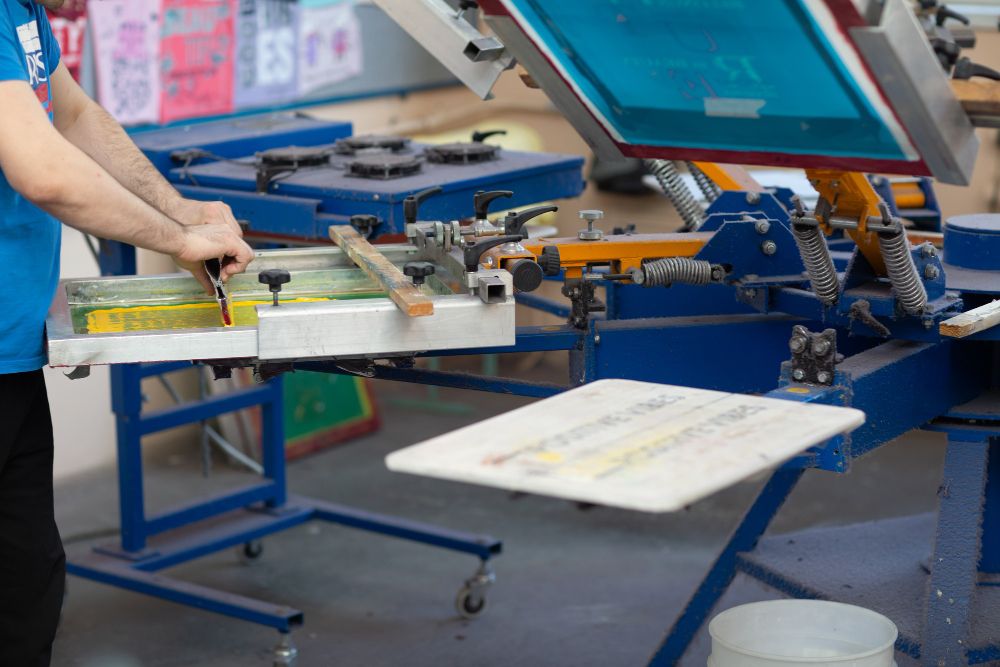
The process starts with your design being separated into individual color layers — one screen per color. Each screen is made by coating a mesh frame with photosensitive emulsion, exposing it to UV light through a film positive of your design, and washing out the unexposed areas to create an open stencil.
During printing, the garment is placed on a platen, the screen is lowered into position, and ink is pressed through the open mesh onto the fabric using a squeegee. Each color requires a separate pass. After all colors are printed, the garment runs through a conveyor dryer at around 320–330°F, which cures the ink and permanently bonds it to the fabric.
The result is a print that's part of the garment — not sitting on top of it. Properly cured screen prints don't crack, fade, or peel under normal washing conditions. They're durable in a way that most other decoration methods aren't.
Key Terms Worth Knowing
- Spot color — a single ink mixed to match a specific Pantone reference. Each color in your design is a separate spot color and a separate screen. This is the standard for logos, wordmarks, and clean graphic designs.
- Underbase — a white ink layer printed first on dark garments before the color layers go down. Without it, colors appear dull or washed out against a dark substrate.
- Registration — the precise alignment of each color screen relative to the others. Tight registration = clean, sharp edges where colors meet. Loose registration = visible gaps or overlaps.
- Curing — the heat process that bonds the ink to the fabric. Under-cured ink washes out; properly cured ink lasts the life of the garment.
- Simulated process — a technique that uses halftone dot patterns to simulate gradients and multiple tones from a limited ink set. Used for photorealistic designs and vintage-style artwork.
- Tonal printing — a specialty technique that matches the ink color to the fabric, creating a "there-but-not-there" effect. Subtle, sophisticated, and increasingly popular in fashion-forward apparel.
What to Bring to a Screen Printing Order
- Artwork: Vector files (.AI, .EPS, .PDF) are ideal. Raster files need to be at 300 DPI at actual print size. RGB doesn't convert reliably to ink — provide Pantone Coated (PMS C) references for every color.
- Garment: The blank affects ink adhesion, coverage, and how the finished product wears. Know the style, colorway, and size breakdown before requesting a quote.
- Quantity: Screen printing improves economically with volume. Price breaks typically occur at 50, 75, 100, 150, 250, 500, and 1,000 pieces.
- Placement and size: Standard chest prints run 12 to 14 inches wide. Oversized (jumbo) prints can extend up to 17 to 18 inches. Left chest logos typically run 3.5 to 4.0 inches.
Five Projects That Show the Range
Screen printing handles a wider range of design styles and garment types than most buyers realize. Here's a look at five projects from our shop that illustrate that range.
Rush Screen Printing on Lane Seven LST002 Vintage Crewneck Tees — 150 Units in 2 Days
150 Lane Seven LST002 vintage crewneck tees with simulated process screen printing, custom neck tags, and retail finishing — completed in 2 business days on M&R Challenger presses. The LST002's 100% cotton vintage surface pairs naturally with simulated process halftone work, which is what produces that soft, worn-in graphic quality. Getting this done in 2 days with retail finishing included is what in-house production on automatic presses with a coordinated finishing workflow actually makes possible.
Custom Streetwear Printing on Lane Seven LS16005 in Lunar Rock
Custom screen printing on the Lane Seven LS16005 in Lunar Rock — a pigment-dyed, warm-gray colorway that gives screen-printed graphics a distinctly different context than printing on black or white. The LS16005 is a 6.1 oz combed ring-spun cotton tee with retail-forward profile, and the Lunar Rock colorway was a deliberate brand choice. Printing on a mid-tone pigment-dyed blank requires careful ink selection to ensure colors read correctly against the substrate — this is the kind of production variable that separates experienced shops from basic print operations.
Tonal Screen Printing — Subtle, Minimal Branding
Tonal screen printing uses ink mixed to match the garment color closely — creating a design that's visible in person, especially under direct light, but reads as texture rather than contrast. The effect is sophisticated and intentional: the brand is present without competing with the garment. Custom Pantone mixing is required to hit the right tonal relationship, and a sample approval step is essential before production — the difference between a tonal print that reads correctly and one that disappears entirely is a very small delta in ink color.
Rush Screen Printing on A4 N4190 Mesh Football Jerseys — 250 Units in 3 Days
3-color plastisol screen printing on A4 N4190 mesh football jerseys, 250 units completed and couriered in 3 business days. Mesh fabric is one of the more demanding substrates for screen printing — the open weave structure requires careful ink deposit management to prevent bleed-through, and registration on a stretch fabric has to account for how the material behaves under press tension. Delivering 250 units in 3 days on a rush, finished and couriered, required both technical setup and real production capacity working simultaneously.
The Shop Uninterrupted — Custom Screen Printing on LA Apparel 1801GD
Custom screen printing on the LA Apparel 1801GD for The Shop Uninterrupted — a heavyweight, garment-dyed blank that's become the standard for premium streetwear and entertainment-adjacent apparel. The 1801GD's 6.5 oz cotton construction gives screen-printed graphics a depth and presence that lighter blanks don't. For brands where the garment itself is part of the brand statement, the blank selection and the decoration method work together — this project is a clean example of what that looks like when both are chosen intentionally.
Ready to Start?
We handle screen printing starting at 50 pieces, with a dedicated account rep on every order, artwork review before production, and a print sample before the full run begins.
Request a quote and hear back within two hours, or explore our screen printing service.