Jumbo Print Projects We've Run: When Going Big Actually Changes the Game
There's a difference between a shirt with a graphic on it and a shirt that is the graphic. Jumbo screen printing is the technique that creates the second one — a print that extends across the full torso, reaches toward the sides, and fills the garment in a way that standard chest printing simply can't. When it's executed well, the design doesn't sit on the shirt. It takes it over.
Here's what jumbo printing actually involves, when it earns its place in a project, and what it's looked like in real production runs we've completed.
What Makes a Print "Jumbo"
Standard chest printing typically covers 12 to 14 inches wide at most, centered on the front. Jumbo printing extends that — up to 16 to 18 inches wide — and often runs lower toward the hem or higher toward the neckline, creating coverage that references the full scale of the garment rather than a defined placement zone.
The technique itself isn't different from standard screen printing. The same ink, the same screens, the same curing process. What changes is the press setup — jumbo printing requires larger screens and a longer stroke on the automatic press, along with precise alignment across a larger surface area. Misregistration that would barely show at standard scale becomes visible at jumbo scale, which is why press calibration and experienced setup matter more for oversized work.
Jumbo printing also pairs naturally with simulated process technique — the halftone-based method that creates the appearance of unlimited colors and photorealistic gradients from a limited set of inks. Because the print area is large, the detail in simulated process work reads more clearly at jumbo scale than it would compressed into a standard chest print.
When Jumbo Is the Right Call
Not every project benefits from going oversized. A small logo or a simple wordmark gets lost at jumbo scale — the design needs to earn the space it occupies. Jumbo printing works best when:
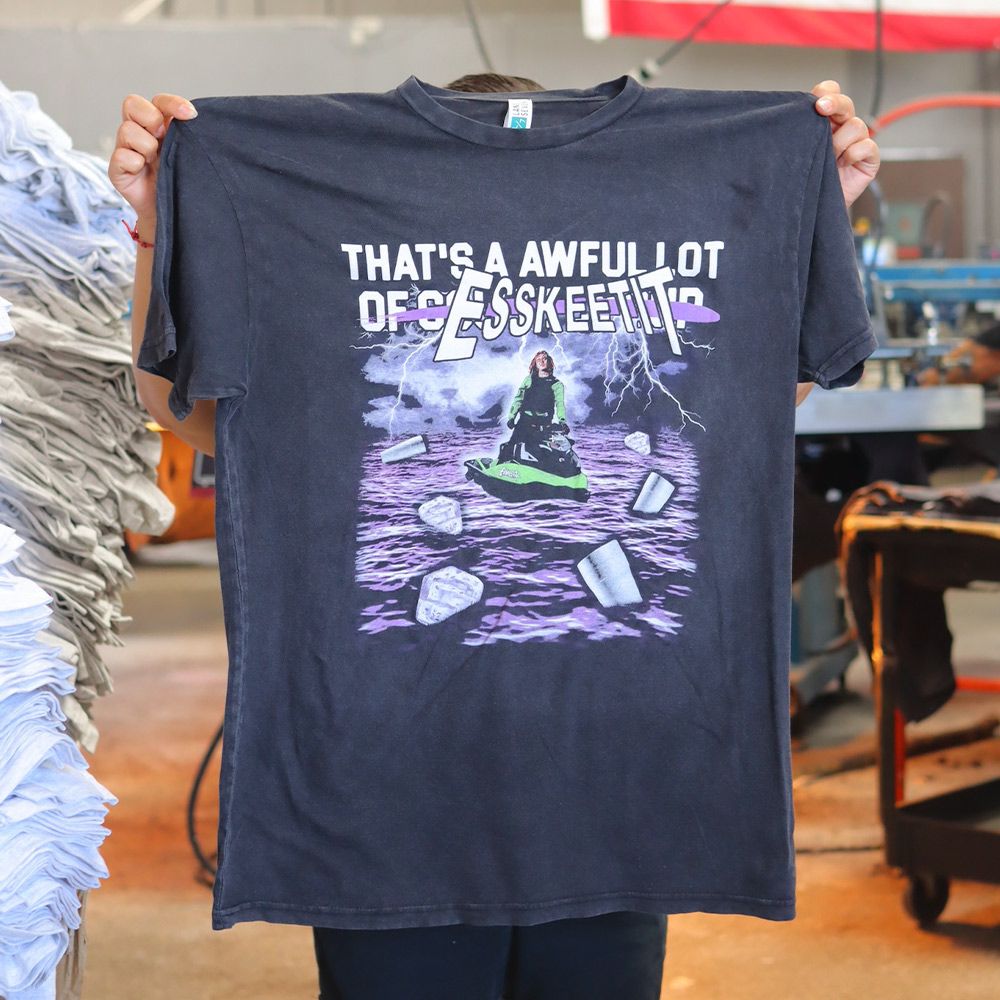
- The artwork is a scene, illustration, or cinematic graphic meant to fill the garment
- The brand aesthetic is streetwear, artist merch, or drop culture — contexts where the visual impact of the garment itself is part of the product
- The design has enough complexity or color range to benefit from the larger rendering area
For standard logo programs, corporate uniforms, or clean wordmark tees, standard screen printing is almost always more appropriate. Jumbo is a deliberate creative choice, not a default.
Projects from Our Shop
Here are five jumbo print projects that show what the technique looks like across different artwork styles, blanks, and timelines.
Chris Jacoub: Gravity Hoodie — Jumbo Simulated Process + Tonal Embroidery on IND420XD
A dual-decoration project combining jumbo simulated process screen printing on the back with black-on-black tonal embroidery on the front of an Independent Trading IND420XD premium hoodie. The back design features a space-themed illustration — planets, an astronaut, multi-color detail — printed at jumbo scale using M&R Challenger 3 automatic presses. The tonal embroidery on the front uses Madeira Polyneon black thread to create a subtle, premium branding element that contrasts in texture with the bold back print. It's a project that shows what happens when jumbo printing is treated as part of a deliberate design system rather than just a large graphic.
Kill Bill-Inspired T-Shirts — 8-Color Jumbo Simulated Process, 350 Units in 2 Days
350 LA Apparel 1801GD black tees with an 8-color simulated process jumbo front print, custom screen-printed neck tags, retail finishing, and direct courier delivery to downtown Los Angeles — all in 2 business days. The Kill Bill-inspired design required multiple shades of yellow, red, white, and gray rendered through halftone separation on black fabric, where underbase management and color sequencing are especially critical. The 1801GD blank was the right choice for this project: its 6.5 oz heavyweight cotton construction holds ink without bleed and gives simulated process halftones the surface density to render cleanly at jumbo scale. Completing 350 retail-finished pieces in 48 hours and couriering them directly to LA is what in-house M&R press capacity on a rush workflow actually makes possible.
2024 Boston Celtics NBA Championship T-Shirts — 350 Units in 48 Hours
Another 350-piece, 48-hour run — same blank, same method, completely different artwork. The championship design required 8 colors including multiple shades of green, gold, white, tan, and gray, separated into halftone channels to produce smooth gradients and accurate color on a black 1801GD tee. The client received a photo of the first production print via text before the full run began — a confirmation step that matters on rush jobs where there's no time to fix a direction error mid-production. Custom screen-printed neck tags and retail finishing were included. The order was couriered directly to the client to guarantee on-time delivery with no carrier delay risk. Two rush projects, same format, different designs — consistent result.
Jumbo Screen Printing on LA Apparel 1801GD Streetwear T-Shirts
Jumbo screen printing on the LA Apparel 1801GD for a streetwear brand — a project that shows the technique in its most natural application. The 1801GD is the default blank for this category of work: garment-dyed, heavyweight, with a tight cotton weave and a boxy oversized silhouette that gives jumbo artwork room to live on the garment. When the design is built for the blank and the blank is built for the print, the result reads as a product rather than a decorated shirt.
Rush Jumbo Screen Printing — Simulated Process on LA Apparel 1801GD
150 LA Apparel 1801GD heavyweight black tees with a 6-color simulated process jumbo front print and custom neck tags, completed in 2 business days. Simulated process at jumbo scale on a black garment is one of the more technically demanding combinations in screen printing — the underbase has to be managed carefully to avoid muddying the halftone detail, and color sequencing across six channels needs to produce accurate tones without bleed at the expanded print area. At 150 pieces on a 2-day rush, the project required both technical precision and production speed working simultaneously.
Ready to Run a Jumbo Print Project?
We handle jumbo screen printing starting at 50 pieces, with rush production available for time-sensitive drops. Our account reps review artwork before production to confirm it's built for the scale.
Explore our jumbo screen printing service → or request a quote and hear back within two hours.